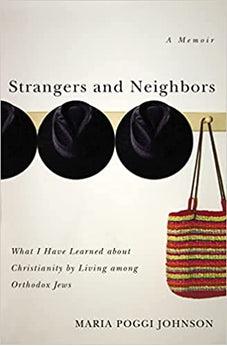
Strangers and Neighbors: What I Have Learned about Christianity by Living Among Orthodox Jews
From Publishers WeeklyA Catholic and a professor of theology at the University of Scranton, Johnson lives near a small community of ultra-Orthodox Jews. In this winsome volume, she explores the ways friendships with her neighbors have subtly reshaped her own Christian commitments. She finds the Jewish practice of reading Torah alongside Talmudic commentary enjoyable and recognizes that she, too, likes to study the Bible with "partners"-be they the ancient church fathers or her husband. In the Jewish dietary codes, Johnson finds a model of bodily spirituality, a useful antidote to the Gnosticism that has historically infected the church. Johnson isn't moved by every aspect of Jewish life; while she shares the goal of imparting religious convictions to her children, she worries that her neighbors' approach-more or less cutting their children off from wider American culture-carries too great a cost. Still, she sees life in her neighborhood as "elementary preparation for civilized participation in the global village." At times, the book is thin-her ruminations on Jewish suffering are so brief as to seem glib, for example. But on the whole, this is a welcome contribution to the literature of Jewish-Christian relations. (Nov. 7)Copyright © Reed Business Information, a division of Reed Elsevier Inc. All rights reserved.In a compelling memoir, a devout Christian woman shares her experience in deepening her faith while living in community with deeply observant Orthodox Jews. Original.Review"...a welcome contribution to the literature of Jewish-Christian relations." -- Publishers Weekly, Nov 7, 2006
Product Information
Product Information
Shipping & Returns
Shipping & Returns
Description
From Publishers WeeklyA Catholic and a professor of theology at the University of Scranton, Johnson lives near a small community of ultra-Orthodox Jews. In this winsome volume, she explores the ways friendships with her neighbors have subtly reshaped her own Christian commitments. She finds the Jewish practice of reading Torah alongside Talmudic commentary enjoyable and recognizes that she, too, likes to study the Bible with "partners"-be they the ancient church fathers or her husband. In the Jewish dietary codes, Johnson finds a model of bodily spirituality, a useful antidote to the Gnosticism that has historically infected the church. Johnson isn't moved by every aspect of Jewish life; while she shares the goal of imparting religious convictions to her children, she worries that her neighbors' approach-more or less cutting their children off from wider American culture-carries too great a cost. Still, she sees life in her neighborhood as "elementary preparation for civilized participation in the global village." At times, the book is thin-her ruminations on Jewish suffering are so brief as to seem glib, for example. But on the whole, this is a welcome contribution to the literature of Jewish-Christian relations. (Nov. 7)Copyright © Reed Business Information, a division of Reed Elsevier Inc. All rights reserved.In a compelling memoir, a devout Christian woman shares her experience in deepening her faith while living in community with deeply observant Orthodox Jews. Original.Review"...a welcome contribution to the literature of Jewish-Christian relations." -- Publishers Weekly, Nov 7, 2006